
Never mind the prompt
If you’ve been anywhere near a staff training day in the last couple of years, you’ll have met the prompt evangelist. They have a slide about working with AI. The slide has a formula. Role, context, task, format, tone, and possibly a sprinkle of “take a deep breath”. Get the incantation correct, they tell you, and the machine will do the rest.
I don’t want to knock it. A clear request does tend to get a better response, whether it’s a chatbot or a 9 year old. But a new study in the International Journal of Educational Technology in Higher Education suggests the words you type at the start may matter less than what you do once the answer arrives.
The short version: when student teachers used AI to help write lesson plans, the ones whose plans came out best weren’t distinguished by smarter prompts. They were distinguished by a habit of reading the AI’s work critically, deciding what was wrong with it, and fixing it, again and again and again. The skill that mattered most looked a lot like knowing when to disagree.
How the researchers studied working with AI
The researchers worked with 67 student teachers, each using generative AI to help create a lesson plan. Rather than simply judging the finished plans, they looked closely at how each person worked with the AI: what they asked for, what they did with the reply, whether they pushed back, and in what order all of this happened.
They then sorted the participants by the quality of their finished lesson plans and compared the two groups. What did the people who produced the better plans do differently from those whose plans fell short?
As a former mentor of trainee teachers, I have a soft spot for this choice of task. A lesson plan is a lovely test of judgement. AI can produce something that looks like a perfectly respectable plan in about four seconds: learning objectives, a starter, main activity, plenary, the lot. Whether it would actually work with 9C on a Thursday afternoon is a different question entirely, and only someone who knows about children, the subject and the classroom can answer it.
What they found
The student teachers whose plans were rated more highly tended to work through a deliberate sequence. They planned the task, decided what they actually needed, asked the AI to generate something, critically evaluated what came back, revised it, then evaluated the revised version and went round again if it still wasn’t right.
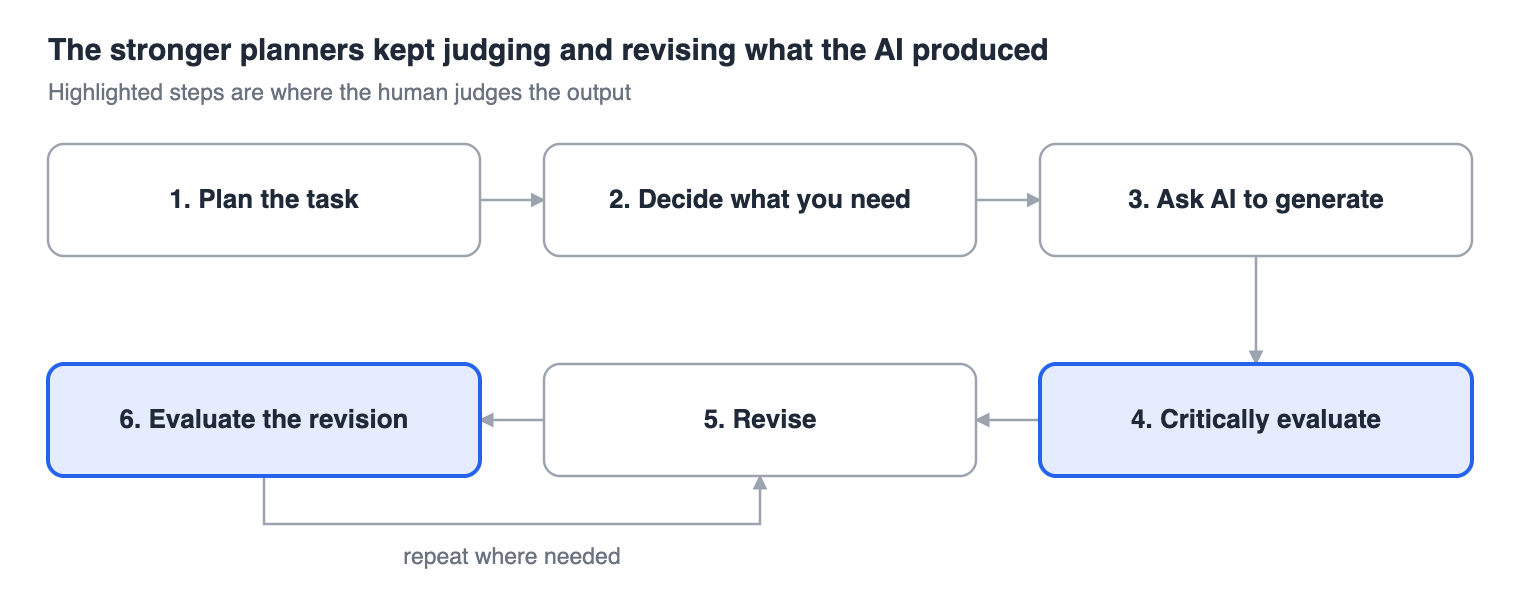
Look at where the AI sits in that cycle. It appears in one step out of six. Everything else is the human thinking: planning, deciding, judging, fixing, judging again.
The group whose plans scored lower were more likely to get stuck in what the researchers describe as unproductive interaction cycles. Every teacher who has tried this will recognise the pattern. You ask, you get something not quite right, you ask again in slightly different words, you get something else not quite right, and round you go, without ever pinning down what is wrong or why. It’s the digital equivalent of repeating a question louder to a tourist.
Two other findings caught my eye. First, the higher-quality group reported less mental demand and less frustration, even though they reported putting in broadly similar effort. Working deliberately seems to have made the job feel easier, not harder. Second, the researchers saw the same main pattern again when the same participants tackled a second task, which suggests it wasn’t just a fluke of one afternoon.
Working with AI: the very confident intern
The way I’ve come to think about generative AI is as an extremely quick, extremely confident intern. It has read an enormous amount, it never gets tired, and it will hand you a polished draft before you’ve finished your coffee. It’s also capable of being wrong in the same calm, assured tone it uses when it’s right. It doesn’t blush.
That combination is a known hazard. Psychologists have long talked about automation bias, our tendency to trust what a machine tells us and to stop checking, especially when we’re busy. A survey of knowledge workers by researchers at Microsoft and Carnegie Mellon, published in 2025, pointed the same way: people who trusted AI more tended to report putting less effort into critical thinking about its output. The better the draft looks, the less likely we are to read it properly. (We looked at a related question, whether AI makes studying feel easier without necessarily helping students learn more, in Less Frazzled, But Any Wiser?)
What I find encouraging is that other research on student teachers lines up with this study, and some of it goes a step further. A study from the University of Oulu assigned 33 trainee teachers to two kinds of preparation. One group was trained on the AI tools alone. The other also had training in a particular mindset about working with AI. The two groups ended up using AI in noticeably different ways, which the researchers labelled “reflective iterative” and “linear extraction”, and the reflective group’s lesson plans scored significantly higher. That’s a small study too, but because people were assigned to the training rather than sorted afterwards, it hints that this way of working can be taught.
Another small study, of student teachers in China planning lessons collaboratively with AI, found that the AI was most helpful at the start, when generating ideas, and contributed less as the work moved into later rounds of refinement. Which rather makes sense. The intern is brilliant at a first draft. Knowing whether the draft is any good is still your job.
Working with AI: marking the thinking, not just the product
If the valuable part of working with AI is the judging and revising, then that’s the part we should be teaching, and the part we should be looking at when we assess.
This is a genuine shift. For most of educational history, the finished essay or the finished lesson plan was a decent stand-in for the thinking that went into it. With AI in the room, that link is much looser. Two plans can look equally polished while one represents an hour of careful judgement and the other represents a single prompt and a hopeful click.
A few ideas that might help, whether you’re training teachers or teaching sixth-formers:
Ask for the trail. Alongside the finished piece, ask students to share their AI conversation, or a short note on what they asked for, what they rejected and why. The “why” is where the learning lives.
Make critique the task. Give students an AI-generated answer, lesson plan or essay and ask them to find what’s wrong with it. It’s a surprisingly demanding exercise, and it trains exactly the muscle this study points to.
Name what you need before you ask. The stronger planners decided what they needed before they asked for anything. Encourage students to jot down, in a sentence or two, what a good answer would look like, so they have something to judge the AI’s version against.
Teach a specific way of pushing back. “Make it better” gets you nowhere. “The starter assumes they already know what a ratio is, but this is their first lesson on it; rewrite it so it begins from something they’ve met before” gets you somewhere. Specific disagreement is a skill, and it can be modelled.
None of this is new to good teachers. We’ve always wanted students to show their working and explain their reasoning out loud. AI just makes it urgent.
Disagreement as a way of thinking
There’s something rather old-fashioned about the skill of working with AI that this study points to, and I mean that as a compliment.
Disagreeing well has always been near the heart of education. Socrates made a career, and eventually a rather unfortunate end, out of politely questioning confident answers. Every decent essay involves weighing one view against another. Every good editor is, at bottom, a professional disagreer. To push back on something, you have to understand it, compare it with what you know, and decide what it ought to have said instead. That’s thinking in its most active form.
What’s new is the sort of thing we’re disagreeing with. A textbook doesn’t change when you argue with it. A colleague might get defensive. An AI will cheerfully produce a new version every time you object, with no ego and no fatigue. In one sense that makes it the perfect sparring partner. In another, it’s a trap: because it never pushes back on your pushback, it’s very easy to keep asking without ever deciding what you actually think.
Perhaps that’s the real lesson. The AI can generate endlessly, but it can’t want anything for your lesson. It doesn’t know Jayden needs things in small steps or that the projector in room 14 has been broken since half-term. The judgement about what good looks like has to come from the person using it. In that sense, the most important prompt in any conversation with an AI might not be the first one. It might be the quiet question you ask yourself after every reply: is this actually right?
A note of caution
The sample was small, 67 student teachers, and all from a single university. More importantly, the researchers grouped people by how good their finished plans were. They didn’t randomly assign anyone to work in a particular way. So the study shows that this deliberate cycle goes with better plans. It doesn’t prove that teaching the cycle would improve everyone’s results. It’s quite possible that the participants who were already stronger planners were simply better at judging the AI’s work too. Knowing what a good lesson looks like probably makes it much easier to spot a bad one.
The Oulu study helps a little here, because people were assigned to their training, but it’s small too. We need bigger studies, with different subjects and different kinds of learners, before treating any of this as settled.
Still, the message feels sound to me, and it matches what I see. The people who get the most out of working with AI aren’t the ones with the cleverest opening line. They’re the ones who know what they’re aiming for, read what comes back with a critical eye, and aren’t afraid to say “no, not quite”. That was a pretty good description of a good learner long before chatbots came along. It might just be more important now.
Sources
Human–AI collaborative patterns in instructional design. International Journal of Educational Technology in Higher Education. Published 12 October 2026. Open access.
Preparing preservice teachers for generative AI in lesson planning: a process mining study of AI mindset and tool-only training. University of Oulu repository.
Sun, Y. & Huang, Y. Exploring the role of generative AI in collaborative lesson planning for pre-service teachers. East China Normal University.
Background on automation bias and the 2025 Microsoft and Carnegie Mellon survey of knowledge workers is drawn from general knowledge rather than sources checked for this post.
Leave a Reply